
For many women, the first step into surrogacy does not begin with an application.
It begins with a question.
Could I do this?
Would I qualify?
What does the process actually look like?
How do I know if an agency is the right fit?
What should I watch out for?
What if I am interested, but not ready to apply yet?
Those early questions matter. And they deserve thoughtful, honest answers without pressure.
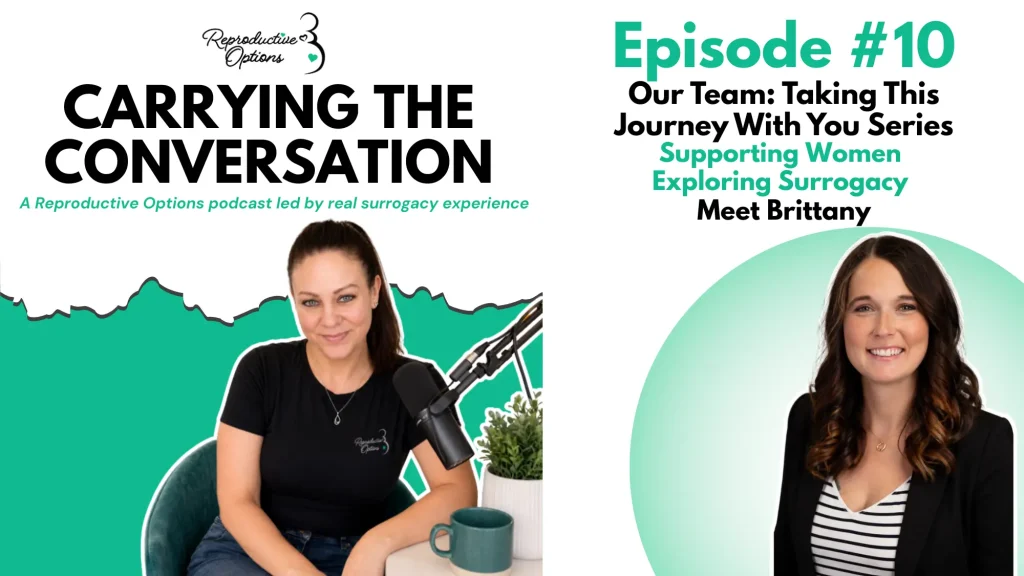
In this episode of Carrying the Conversation, Kayla sits down with Brittany, a two-time surrogate and member of Reproductive Options’ outreach and engagement team. Brittany’s role is often one of the first touchpoints for women who are curious about surrogacy but may not be ready to move into intake.
Her job is not to pressure someone into applying to become a surrogate.
It is to educate, support, answer questions, and help women feel less alone as they explore whether surrogacy may be right for them.
That kind of support is especially meaningful because Brittany knows what it feels like to enter surrogacy without enough education. She has experienced both sides: a first journey where she did not feel fully supported, and a later journey with Reproductive Options that helped her realize how different surrogacy can feel when the right surrogacy agency is beside you.
Meet Brittany, a Two-Time Surrogate
Brittany is a mom of three, a wife, a country-living coffee lover, and a two-time surrogate.
Her first surrogacy journey was for a couple in California. Later, she completed another journey with Reproductive Options, where a single embryo transfer unexpectedly became a twin pregnancy after the embryo split.
That second journey was beautiful, exciting, and challenging in the way twin pregnancies can be. It also gave Brittany a very different experience of surrogacy agency support.
After her first journey, Brittany did not think she would pursue surrogacy again. She had wonderful intended parents, but the surrogacy agency experience left her feeling more like a transaction than a person. She felt she lacked the education and support she needed, and she walked away thinking surrogacy might not be something she wanted to repeat.
Then she met Kayla, founder of Reproductive Options, in a completely unexpected way.
Brittany was pumping after her first surrogacy journey. Around that same time, Kayla had recently had her youngest daughter and was struggling with milk supply after getting sick and needing medication. Through a milk donation group, Kayla found Brittany, who ended up pumping for Kayla’s daughter.
When Kayla arrived at Brittany’s house, she had Reproductive Options branding on her car.
That sparked a conversation.
From there, the two stayed in touch. Brittany learned more about Reproductive Options, Kayla’s vision for her surrogacy agency, and what support could look like when it was built from lived surrogacy experience. Eventually, Brittany decided to do another journey, this time with Reproductive Options.
That journey helped inspire the work she does now.
Why Outreach and Engagement Matters in Surrogacy
Brittany’s role was created to fill an important gap.
Many women are not ready to apply the first time they ask a question about surrogacy. They may be curious, cautious, excited, nervous, or simply gathering information. They may have seen something online, heard about surrogacy from a friend, or had a personal experience that made them wonder whether carrying for another family could be right for them.
But the online surrogacy world can be overwhelming.
Some surrogacy groups are helpful and supportive. Others can feel harsh, confusing, or, as Kayla and Brittany described it, “muddy.” People often bring strong opinions based only on their own experience, and while personal experience is valuable, it is not always universal.
Surrogacy is complex.
It can be emotional, exciting, difficult, beautiful, traumatic, empowering, and deeply personal all at once. No two surrogacy journeys are exactly the same, which means education should come with nuance and compassion.
Brittany’s role is to be a softer landing place.
She can answer questions, offer resources, talk through concerns, help women understand what the surrogacy process looks like, and provide support without making anyone feel like they are being recruited or rushed.
That difference matters.
Surrogacy Education Without Pressure
One of the strongest themes in Brittany’s episode is education without pressure.
At Reproductive Options, the goal is not for every conversation to end in a surrogate application. The goal is for women to understand what they are considering.
That may mean moving forward with Reproductive Options.
It may mean choosing another surrogacy agency.
It may mean deciding an independent journey is the better fit.
It may mean realizing surrogacy is not safe, not right, or not the right timing.
All of those outcomes are valid.
Brittany shares that she wants women to know they do not have to choose Reproductive Options, but they do need to be informed. That is especially important because there can be so much a first-time surrogate does not know she does not know.
Before her first journey, Brittany did not join surrogacy groups. She came into the process with a good heart, strong pregnancies, and the belief that she could help someone else carry a baby.
Those things mattered.
But she learned quickly that surrogacy is about more than being able to carry a healthy pregnancy. It also requires education, support, communication, advocacy, and a strong understanding of what to expect from the people guiding the journey.
Now, she helps others ask the questions she wishes she had known to ask.
“You Deserve Better”
Brittany’s first surrogacy agency experience shaped her deeply.
She had great intended parents, but the support around the journey did not feel like what she needed. Afterward, she was asked almost immediately whether she would do another journey and whether it would be with that same surrogacy agency.
That did not feel supportive.
It felt transactional.
What stood out to Brittany about Kayla and Reproductive Options was the opposite feeling. Instead of asking, “Are you going to do this again?” the questions were, “How are you feeling?” “What do you need?” “How can we support you?”
That difference changed everything.
It helped Brittany realize that there are better experiences available. It helped her want to do another journey. And now, it motivates her to show other women that if they had a hard experience elsewhere, or if something feels off during the research process, they deserve support that feels human, personal, and aligned.
Surrogates should not feel like numbers.
They should feel heard.
A Day in Brittany’s Surrogacy Role
Brittany describes her day-to-day work in a way that feels very true to her personality.
First, coffee.
Then she checks messages from potential surrogates and people who are simply looking to learn more about the surrogacy process. She checks her platforms, keeps track of conversations in what she calls her “brain book,” follows up with people who may need additional support, and looks through surrogacy spaces online to see where someone may need advice or a listening ear.
That “brain book” detail says a lot.
Brittany is not just responding to messages and moving on. She is keeping track of people, remembering what they shared, and checking back in so they know someone is there.
Sometimes, that is exactly what a potential surrogate needs.
Not a sales pitch.
Not pressure.
Not a rushed application link.
Just someone saying, “I remember you. I’m here. How are you feeling about this?”
The First Questions Potential Surrogates Ask
A lot of the early questions Brittany receives are about intended parent matching.
That makes sense.
The match is one of the most personal parts of surrogacy. A surrogate may wonder whether she can match with intended parents who want a close relationship. Another may prefer more boundaries and wonder if that is allowed. Someone may have strong preferences around communication, location, values, termination stance, vaccination, or what kind of relationship she wants during and after the journey.
Brittany encourages women not to be afraid of those preferences.
Matching points are not something to be ashamed of. They help build a better journey for both sides.
If a surrogate knows she wants open communication, that matters. If she knows she prefers more distance, that matters too. If intended parents have certain hopes, needs, or values, those matter as well.
The goal is not to force everyone into the same version of surrogacy.
The goal is to find alignment.
As Brittany explains, every surrogate and intended parent deserves the chance to have the best possible experience, especially because for some people, this may be their only surrogacy journey.
Intended Parent Matching Should Not Feel Like Pressure for Surrogates
Kayla and Brittany also talk about the pressure that can happen around match calls.
Some surrogates have experienced match calls where both sides are asked, on the call, whether they want to confirm the match. That can create an uncomfortable emotional situation.
What happens if one side is unsure?
What if the intended parents are lovely, but not the right fit?
What if a surrogate feels guilty saying no?
What if intended parents feel rejected when the issue is simply compatibility?
Brittany shared that she would struggle in that situation because she does not like to break hearts. She could imagine herself saying yes just to avoid hurting someone, even if she was not fully sure.
That is exactly why pressure-free matching matters.
A strong surrogacy agency should help guide the match call, support the conversation, and give both sides space afterward to decide privately whether they want to move forward. If it is not the right fit, that news should be handled with care.
A “no” does not mean something is wrong with the surrogate.
A “no” does not mean something is wrong with the intended parents.
Sometimes it simply means the connection is not the right one.
That distinction matters.
Surrogate Benefits Packages Should Fit Real Life
Another common topic Brittany discusses with potential surrogates is the benefit package.
Many women do not realize how many details can be included in a surrogacy benefit package or how much those details can affect their household. Childcare, mileage, travel, maternity clothing, housekeeping, lost wages, pumping, transfer fees, medical-related needs, and other benefits can look different from one surrogate to another.
That is why a “take it or leave it” package can be a red flag.
Every surrogate’s life is different.
One person may need more childcare support. Another may live farther from her OB or delivery hospital. Someone else may have a different work situation, support system, or family structure. A surrogate benefits package that works for one surrogate may not work well for another.
Brittany helps women understand that they can ask questions about benefits and think through what they actually need to feel supported.
The point is not only compensation.
It is reducing stress.
When a surrogate feels supported, heard, and protected, it creates a better experience for her, her family, the intended parents, and the baby she is carrying.
A Surrogate Community That Feels Personal
Another resource discussed in the surrogacy podcast episode is Reproductive Options’ private Facebook group.
The group is intentionally small and includes surrogates who are going through surrogacy intake, currently in a journey, or have previously been surrogates with Reproductive Options. It also includes repeat surrogates who are finished with their own journeys but still want to support and educate others.
That kind of community can be incredibly valuable.
Surrogates often remain passionate about surrogacy even after their own journeys are over. They may not go on to work in the field, but they still want to help other women understand the surrogacy process, ask better questions, and feel less alone.
Brittany points out that the Facebook group is small by design. It is not about building the biggest community possible. It is about making sure each surrogate feels like she matters, her questions are heard, and her needs are not lost in a crowd.
That reflects the larger Reproductive Options approach.
Support should feel personal.
The Surrogacy Guidebook and Real Resources at Reproductive Options
Brittany also uses the Reproductive Options surrogacy guidebook often.
When someone wants to understand the surrogacy process, she does her best to walk them through each step, explain why it matters, and help them understand the timeline. Then she can send the guidebook as a resource they can revisit.
The surrogate guidebook helps explain the lingo, acronyms, stages, and expectations that can feel confusing when someone is new to surrogacy.
Brittany has even sent it to intended parents, explaining that while it is geared toward surrogates, it can help them better understand what the surrogate may go through.
That matters because education should not only exist on one side.
Surrogates need to understand what intended parents may be feeling. Intended parents need to understand what surrogates may experience. When both sides have more context, there is more empathy, more realistic expectation-setting, and more room for a healthy relationship.
Choosing a Surrogacy Agency for Who They Are
Toward the end of the episode, Brittany shares one of the most important pieces of advice for anyone considering surrogacy: choose a surrogacy agency not just because of what they offer, but because of who they are.
A high surrogate compensation number may get someone’s attention. A flashy promise may sound appealing. A quick intended parent match may feel exciting.
But none of that replaces real support.
Brittany encourages women to think carefully about who they are trusting with their surrogacy journey. Whether someone chooses a surrogacy agency or an independent route, she should feel informed, supported, and confident in the people around her.
That means knowing red flags.
It means asking questions.
It means understanding the process.
It means feeling comfortable enough to say when something does not feel right.
It means choosing people who match your values, not just your budget goals.
Surrogacy is too personal to be guided only by the biggest price tag.
Why Firsthand Experience Matters in Surrogacy Support
Brittany’s role is especially powerful because she has lived what she now talks about.
She has been a surrogate.
She has experienced a journey where support felt lacking.
She has experienced a journey where support felt strong.
She has carried a singleton pregnancy and a twin pregnancy.
She has pumped.
She has navigated intended parent relationships.
She has learned what she wishes she knew earlier.
That firsthand experience allows her to speak to potential surrogates with honesty and empathy.
She also knows when she does not have the answer. And when that happens, she is comfortable saying, “I may not know that, but let me ask someone who can better guide you.”
That is its own kind of trust.
A good support person does not need to pretend to know everything. She needs to know how to help someone find the right answer.
Surrogacy Can Be Amazing With the Right People
This episode does not pretend surrogacy is always simple.
It is not.
Surrogacy can be emotionally complicated. It can involve hard conversations, confusing decisions, medical unknowns, matching disappointments, online noise, and moments where a woman realizes she needs more support than she expected.
But Brittany and Kayla also remind listeners that there is so much good in surrogacy.
There are beautiful relationships.
There are intended parents who get to grow their families.
There are surrogates who feel deeply fulfilled.
There are surrogacy agency teams working hard to do things ethically and personally.
There are communities where questions are welcomed instead of judged.
Surrogacy can be amazing when the right people are involved.
That is the heart of Brittany’s message.
Do not rush.
Do not ignore red flags.
Do not choose only based on compensation.
Do not be afraid to ask questions.
Do not assume one bad experience means every experience will be the same.
Get educated. Know what you need. Choose support that feels aligned. And make sure the people around you are people you can truly talk to.
Surrogacy Support Starts Before Intake
Brittany’s episode is a reminder that great support should not begin only after a surrogate has applied.
It should start the moment she begins asking questions.
Before intake, before matching, before medications, before transfer, and before pregnancy, there should be space for honest conversation. That is what surrogacy outreach and engagement is meant to provide.
For Brittany, this work is personal. She knows how different surrogacy can feel when a woman is educated, supported, and heard. She knows what it feels like to wish she had more information earlier. And she knows how powerful it can be when someone simply shows up without pressure.
That is why her role matters.
Because sometimes the first step is not a surrogate application.
Sometimes the first step is a conversation with someone who says, “Ask me anything. I’m here to help.”
Curious about becoming a surrogate but not ready to apply yet? Connect with Reproductive Options for pressure-free education, real surrogate experience, and honest answers about matching, surrogate benefits, support, and what the journey can look like from the very beginning.