

Will they think I’m too emotional?
Does a Zoloft prescription from three years ago disqualify me?
What if I don’t feel attached to the baby?
What if I do?
Am I even allowed to say something doesn’t feel right?
Most of the hardest questions in surrogacy never make it onto an intake form. They live quietly underneath it. They live in the moments before a psych evaluation, in the silence after a failed transfer, in the strange grief of delivering a baby that was never yours to keep.
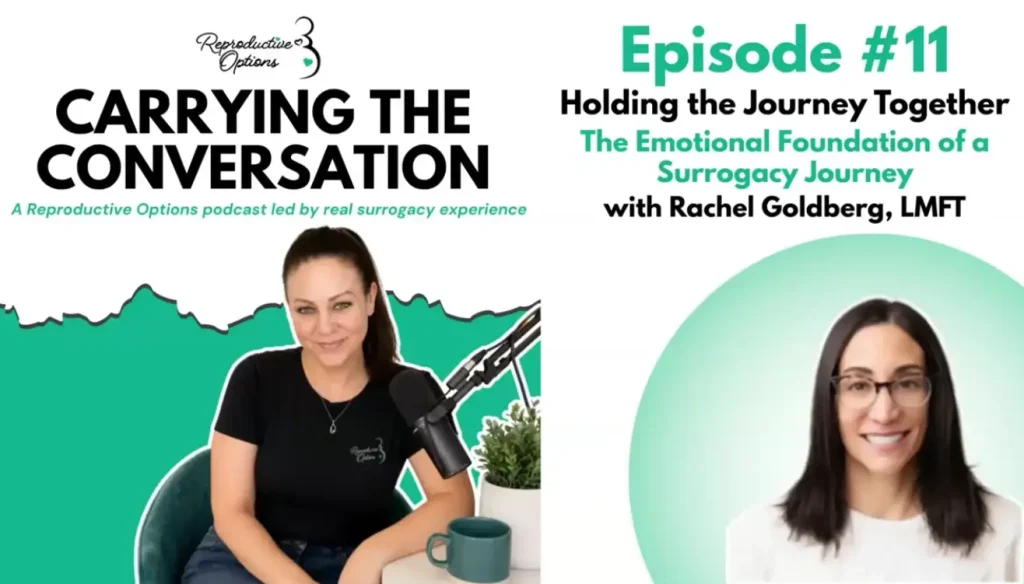
In this episode of our surrogacy podcast, Carrying the Conversation, Kayla and Gabby sit down with Rachel Goldberg, LMFT, a therapist who has spent her career working in infertility and third-party reproduction. Rachel does the psychological evaluations for Reproductive Options’ gestational carriers, provides counseling for intended parents from day one, and now stays with both sides for the entire journey.
That last part is key and is not found with every surrogacy agency’s journey.
This conversation is about what real mental health support in surrogacy actually looks like — not as a box to check, but as the backbone to support the entire journey.
Meet Rachel Goldberg, LMFT
For Rachel, she didn’t set out to specialize in surrogacy. She got there sideways, like many of us.
While putting herself through graduate school at USC, she worked as a personal trainer, then earned an additional certification to train perinatal clients. One client needed an emergency hysterectomy after giving birth and later built her family through a gestational carrier. Rachel had never encountered surrogacy before. But she was in West Hollywood, at a moment when same-sex couples were increasingly building families this way, and she got to watch that entire journey unfold up close.
She points out something people rarely think about: clients tell a personal trainer more than they tell a therapist. Trainers are woven into the fabric of someone’s life, session after session, for months. Rachel was already fluent in the emotional texture of people’s lives before she ever sat across from a client with a clipboard.
One thing led to another, and she stayed in the perinatal space. Today, she sits at the intersection of two very different emotional worlds — intended parents who may be carrying grief or loss, and surrogates who are enthusiastically, wholeheartedly choosing to help build someone else’s family. She gets to hold both. That balance, she says, is what makes the work so rich.
The Surrogacy Psych Evaluation Is Not There to Eliminate You
Say the words “psych evaluation” to almost anyone considering surrogacy, and you can watch their shoulders tense.
Rachel hears it constantly. So she leads with reassurance, and she means it: the evaluation is not a test designed to find a reason to say no. It exists to protect you, the surrogate, as much as it protects the intended parents.
That reframe matters. A lot of people walk in assuming the evaluation exists purely to make sure surrogates won’t get too attached, won’t cause problems, and will simply perform as expected. Rachel wants that assumption gone before the conversation even starts.
“My goal is not to eliminate you,” she says. “My goal is to support you. I hope this works out.”
She is not the person hunting for a reason to disqualify you. She is the person making sure this is genuinely the right time, in the right life circumstances, with the right support around you. A rushed or unready journey isn’t good for anyone, least of all you.
What She’s Actually Screening for in Surrogates
So what does a surrogate evaluation actually cover? Rachel breaks it down plainly:
- Motivation. Yes, surrogate compensation is part of it, and that’s okay! Nobody goes into surrogacy purely for altruism, and nobody should have to pretend otherwise. What Rachel is looking for is alignment: a mix of practical benefit and genuine desire to help build a family.
- Support system. Who’s actually there for you? If bed rest happens, who picks up your kids? If your only support lives three states away, that’s a real gap worth naming before it becomes a crisis.
- Relational dynamics. How do you handle conflict? Do you shut down, escalate, or can you have a hard conversation directly? Can you advocate for yourself when something feels off?
- Risk factors. Unresolved trauma, major life instability, timing that just isn’t right. These get named honestly, not judgmentally, with a foundation of support.
Notice what’s woven through every one of those: your voice, your capacity to say something, your right to be heard as a surrogate. As Rachel puts it, “This is your body. You have that right.” The evaluation isn’t only checking whether you’ll be safe for the intended parents to work with. It’s confirming that you know your voice and feel empowered to use it throughout the entire surrogacy process.
A Zoloft Prescription From Ten Years Ago Doesn’t Disqualify You as a Surrogate
This is where the conversation gets genuinely reassuring.
Rachel has watched the field shift. More and more surrogate candidates come in having taken something like a low-dose antidepressant at some point in their lives. Sometimes it’s prescribed after a hard postpartum stretch, sometimes just because an OB or a PCP said, “here’s a script, this could help.” It’s less taboo than it used to be, and thank goodness for that!
Her threshold isn’t “did this ever happen to you.” It’s “did you handle it well.”
“Someone actually felt like they needed help, and then they went and got help,” she says. “That’s not an automatic no to me. That’s the same thing for therapy too — someone strong enough to say, I need help.”
Compare that to someone who never asked for help at all, and instead found an unhealthy way to cope. Seeking support isn’t the red flag. It’s the green one!
Kayla and Gabby put it just as directly: having gone through something hard and having to take medication to get through it does not mean you need it forever. And it absolutely does not mean the door is closed. Transparency is what keeps that door open. Hiding something you’re worried might disqualify you is far more likely to create a problem than the thing itself ever would.
Why Reproductive Options Made Continuous Surrogacy Support Non-Negotiable
Here’s the shift that prompted this whole conversation: Reproductive Options now requires ongoing mental health support, with one consistent therapist, for every new match. That is for surrogates and intended parents, from evaluation all the way through the journey.
Not a one-time evaluation and a goodbye. Not a rotating cast of providers. One person, the whole way through.
Why does that matter so much? Because the version of you Rachel meets at intake – excited, prepared, surrounded by enthusiastic friends and family – is not necessarily the version of you three months in, when a transfer fails for no discernible reason, and you’re blindsided by a question you never expected to ask yourself: what’s wrong with me?
It’s also because the excitement around you tends to fade for everyone except you. In the beginning, people cheer. As the process continues, that enthusiasm quietly dims for everyone but the surrogate actually living it. “It’s not like we’re bringing a baby home,” Rachel says. Grandma isn’t as thrilled. Your partner has settled back into normal life. And you’re left wondering who, exactly, is your cheerleader now.
That’s what continuity is for. A surrogate isn’t handed off between strangers every time something hard happens. She has someone who already knows her story, her history, and her patterns. She has someone who can catch a shift before it becomes a spiral, and who can’t be talked out of caring by anyone else’s version of events.
A Neutral Space When It’s Not Actually Conflict
One of the most valuable things Rachel offers doesn’t show up on paper at all: she’s neutral.
A surrogate case manager, however well-intentioned, is inside the relationship. If tension appears, someone can start to wonder whether the surrogacy agency is quietly taking sides. Rachel isn’t inside it. She can sit with a surrogate and a set of intended parents and translate what’s actually happening underneath a misunderstanding.
Her example says it all. A surrogate doesn’t hear back from her intended parents right away, and her mind runs straight to worst-case scenarios. Named out loud, in the room, the intended parents realize for the first time what a delayed response actually triggers. Nobody was doing anything wrong. Nobody needed to apologize. They just needed a safe place to say the quiet part out loud.
More often than not, Rachel and Kayla agree: what looks like conflict is actually just a misunderstanding that never had anywhere to land.
The Grief No One Prepares You For in Surrogacy
A failed transfer. A miscarriage. These can happen often, and for reasons that have nothing to do with a surrogate having done anything wrong. But knowing that intellectually and feeling it in the middle of the moment are two very different things.
“The famous last words I hear,” Rachel says, “are: I knew this could happen. I just didn’t think it would happen to me.”
And the grief that follows is its own strange animal. It’s not exactly your pregnancy but you’re grieving. Grieving for yourself, and grieving for the baby that was supposed to exist for someone else. It doesn’t map neatly onto a friend’s miscarriage, even a friend who means well. It’s a complicated, specific kind of loss, and pretending it should feel simpler than it does only isolates the person carrying it.
Having somewhere safe to bring that should not be a luxury. It’s the thing that lets a surrogate actually process what happened instead of quietly carrying it alone.
What Happens After You Deliver a Baby as a Surrogate
Nobody warns surrogates enough about the day after.
For nine months, you are checked in on constantly. You are, in Rachel’s words, treated like a hero. And then the baby is born, and it can feel like a switch flips. The check-ins stop. Everyone else’s life moves forward. Yours is supposed to just snap back to normal.
“All the check-ins stop,” Rachel says. “And because you’re not bringing the baby home doesn’t mean you’re not going to get the hormone dump. You can be confused by that. I don’t know why I’m crying, I don’t really understand this.”
That’s why real postpartum support starts before delivery, not after. Rachel works with surrogates ahead of time on what comes next: What does your work situation look like? What are your plans, so you already have a sense of purpose lined up? What would it feel like if delivery doesn’t go the way you pictured it?
And afterward, she makes space for something surprisingly simple and surprisingly rare: the chance to actually tell your story. The best part. The hardest part. Out loud, to someone who’s listening for it. A family that’s just relieved you’re “back” isn’t always the audience that story needs.
Permission to Feel Whatever You Feel During the Surrogacy Journey
If there’s one thread that runs through this entire conversation on our surrogacy podcast, it’s normalization.
“I don’t feel attached to the baby, and I feel like a monster because I don’t.” “I do feel attached to the baby, but I’m not sure where that’s coming from.” “I don’t know why I’m crying.”
“I have this pull for another journey, and I don’t know what to do with it.”
Rachel’s job isn’t to correct any of those feelings. It’s to make room for all of them, and to help someone figure out what’s underneath. Is it about the baby, about the intended parents, about something else entirely? There’s no wrong answer here, and there’s no feeling that disqualifies you as a person.
Even the good check-ins matter. When nothing is wrong, that’s worth noticing too. Then it’s a chance to acknowledge that things are going well, and to actually let that land.
When You Can’t Do Surrogacy Again
Toward the end of the conversation on our surrogacy podcast, Kayla asks the question a lot of repeat surrogates eventually face: what do you do when your body, your family, or your circumstances mean this chapter has to close but your heart still wants to go back?
Rachel doesn’t offer a tidy answer, because there isn’t one. What she offers instead is permission.
“Acknowledge that it actually is really hard,” she says. “You’re grieving an idea you had — an expectation of what things were going to look like. You have to grieve that it’s not going to look like that. It’s a very painful experience to think you’re going to have this thing happen, and then be told no or not be able to.”
That grief is painfully real, even when nothing “went wrong.” Watching a friend continue on a journey you can no longer take yourself will sting, and that’s allowed too. Name it. Let it pass through. It will.
Real Surrogacy Support That Stays
None of this works as a one-time checkbox. It works because someone stays.
That’s the whole idea behind making continuous mental health support standard for every new surrogate match at Reproductive Options. It’s not an add-on for people who are struggling, but a built-in relationship for everyone, from the very first evaluation through delivery and beyond. Asking questions about how you’ll feel isn’t a warning sign. It’s exactly the kind of proactive, self-aware instinct that makes someone ready for this in the first place.
You are allowed to ask what this will feel like. You are allowed to have needed help before. You are allowed to grieve, to celebrate, to feel nothing you expected to feel and to have someone in your corner through all of it who already knows your story.
Want a surrogacy journey backed by real, continuous mental health support for both you and your intended parents? Connect with Reproductive Options to learn what that relationship looks like from your very first conversation forward.