
Every surrogacy journey begins long before a positive pregnancy test.
For some women, the idea starts with a personal connection to infertility. For others, it comes from a friend, a family member, or a story that stays with them. For Linsay, the idea of surrogacy had been sitting quietly in the back of her mind for years.
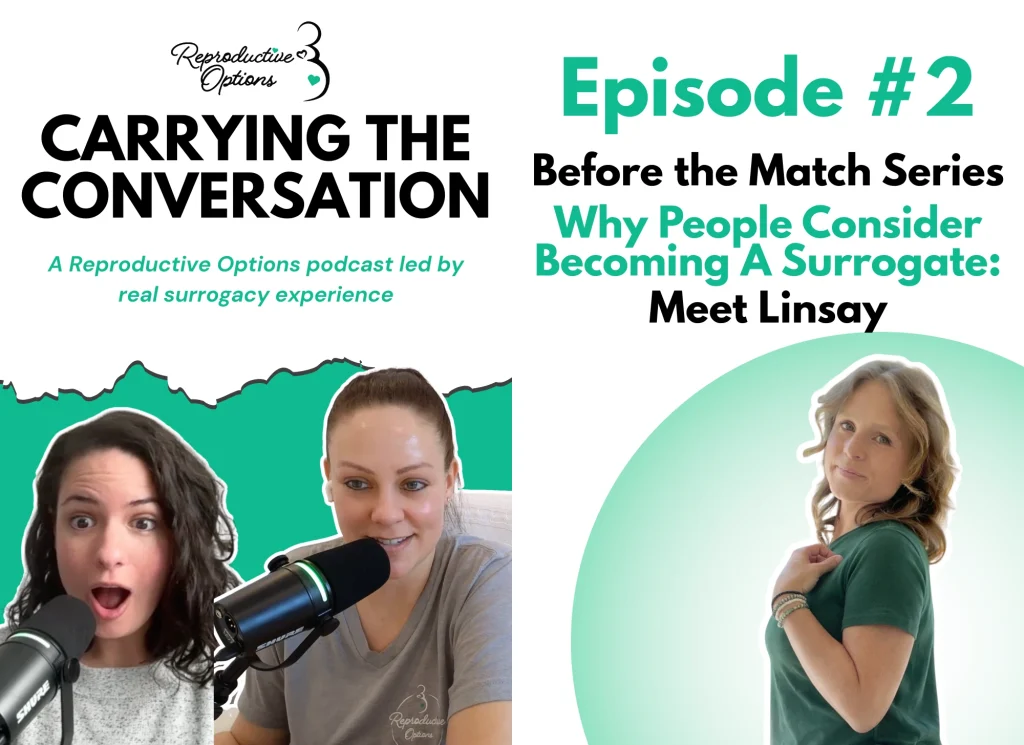
In this episode of Carrying the Conversation, Kayla and Gabby sit down with Linsay, a first-time surrogate who is currently 37 weeks pregnant. Fresh from an OB appointment, Linsay shares what led her to surrogacy, what made her keep going after early roadblocks, and how she is thinking about delivery, postpartum, and what comes next.
Her surrogacy story is honest, funny, emotional, and deeply reflective — exactly the kind of conversation this podcast was created to hold.
A Surrogacy Journey Years in the Making
Linsay’s interest in surrogacy did not appear overnight.
Before having her own children, she met a coworker who was actively carrying as a surrogate. Later, she crossed paths with someone whose mother had been a surrogate multiple times. Those early exposures made an impression.
What stood out to Linsay was not just that these women had chosen surrogacy. It was that they had chosen it more than once.
That stayed with her.
Over time, surrogacy became one of those “one day” dreams — something she thought she might pursue eventually, when the timing was right. Then, at the start of a new year, she found herself sitting in her car before work, thinking about what she wanted to do next.
The question changed from “one day” to “why not now?”
As she began researching the surrogacy process, the idea started to make sense. She was done having children of her own. Her kids were getting older. She knew she did not want to start over with another baby. And she felt drawn to the many different ways families are created.
For Linsay, that part was personal.
She is adopted, has worked with foster children, and has always believed that family is not defined only by biology. Families are built through love, choice, commitment, and connection.
Surrogacy felt like another powerful way to help a family come together.
When the Surrogacy Process Is Not Simple
Although Linsay felt called to surrogacy, the path forward was not immediate or easy.
She had been pursuing the surrogacy journey for just over two years and described the beginning as back-and-forth. For the first several months, she was not sure if surrogacy would actually be something she could do.
As she moved through the early screening process, she learned a lot about herself — not only emotionally, but medically. Like many women, she discovered that there were things in her medical history she had not fully understood before. She also realized that different surrogacy agencies and fertility clinics may interpret records differently.
That part of the surrogacy process can feel discouraging.
Linsay shared that some surrogacy agencies seemed to move away from her quickly. It left her wondering how much effort she was supposed to put in before deciding she had exhausted every option.
Before giving up, she posted in surrogacy community groups and essentially asked: Am I still a surrogate candidate, or is this where I stop?
That step eventually led her to Reproductive Options.
The Importance of Being Seen as an Individual During Surrogacy
One of the most meaningful parts of Linsay’s surrogacy story is the difference it made to feel seen as a whole person.
Surrogacy should always be safe, ethical, and medically appropriate. But that does not mean every surrogate candidate fits neatly into one rigid box. Medical records, fertility clinic requirements, intended parent preferences, and surrogacy agency matching models can all affect whether someone is considered a strong candidate to become a surrogate.
As Kayla explained in the episode, Reproductive Options looks at each person individually. The goal is never to force a match or ignore medical concerns. The goal is to understand the full picture.
That distinction mattered to Linsay.
She noted that there is a difference between telling someone, “We do not currently have the right match for you,” and telling someone, “You are not matchable.”
Those are not the same message.
For women who are already opening themselves up to an emotional, vulnerable, and highly personal process, language matters. Transparency matters. Feeling respected matters.
For Linsay, finding a surrogacy agency that acknowledged her experience, reviewed her situation carefully, and supported her as an individual helped make the journey possible.
Now, she is weeks away from delivery.
The Emotional Transitions Along the Way in Surrogacy
Surrogacy is often talked about as one big journey, but Linsay’s experience highlights that it is really made up of many smaller transitions.
One transition came when she graduated from the fertility clinic to a regular OB. During the fertility stage, there are frequent appointments, regular communication, and a high level of coordination. Then, suddenly, things shift.
Instead of constant updates and ultrasounds, there is more space between appointments. Instead of the fertility team managing so many details, the surrogate may find herself carrying more of the communication herself.
For Linsay, that change felt bigger than expected.
It was one of the first moments where the intensity of the process began to taper. And as she looks ahead to delivery, she is thinking about another transition: what happens after the baby is born?
That is one of the most common questions surrogates hear.
How will you feel afterward?
Will it be hard to leave the hospital without the baby?
What will life feel like when the journey is suddenly over?
Linsay’s answer was honest: she will know when she gets there.
She feels confident in her choice and is clear that she does not want another baby of her own. But she also understands that hormones are real, postpartum is real, and no one can predict every emotion ahead of time.
That kind of honesty is important.
Pumping as a Gradual Ending for Surrogates
One thing Linsay is looking forward to after delivery is pumping for the intended parents.
While waking up in the middle of the night to pump may not sound glamorous, Linsay described it as a helpful way to ease out of the surrogacy journey instead of experiencing a sudden stop.
For months, surrogates are needed in a very active way. There are appointments, medications, monitoring, communication, milestones, and check-ins. Then delivery happens, and the baby goes home with the intended parents.
That can feel abrupt.
Pumping gives some surrogates a continued sense of purpose. It can allow them to keep providing for the family while gradually stepping back from the intensity of pregnancy. Kayla also shared that, when medically appropriate, pumping can support physical recovery and help the body transition postpartum.
For Linsay, it feels like a meaningful bridge between pregnancy and what comes next.
Including Intended Parents in the Pregnancy
Another beautiful part of Linsay’s story is the relationship with her intended parents.
At her recent appointment, one of the intended parents was able to attend in person. Linsay shared a sweet moment where the midwife helped him feel where the baby was positioned and guided his hands so he could participate more fully in the appointment.
That kind of inclusion matters.
Surrogacy is unique because the person carrying the pregnancy is not the parent, and the parents are not the ones physically experiencing the pregnancy. Supportive providers can make a huge difference by recognizing that dynamic and helping intended parents feel connected in appropriate, respectful ways.
For Linsay, the appointment was heartwarming. For Kayla and Gabby, it was also a reminder of how meaningful it is when medical providers understand and support surrogacy well.
Navigating Insurance and Medical Care as a Surrogate
Linsay also opened up about the complications that can come with insurance and medical care during a surrogacy journey.
She shared that switching providers late in pregnancy was chaotic, but ultimately worth it. Her delivery hospital is now much closer to home, her providers feel more supportive, and she has felt more comfortable with the care model.
The conversation also touched on a broader issue in surrogacy: insurance can be complicated, inconsistent, and, at times, frustrating.
Some practices are incredibly supportive. Others may be unfamiliar with surrogacy or hesitant because of insurance structures, liens, billing concerns, or misunderstandings about the process.
For surrogates, this can add stress to an already layered experience.
That is one reason surrogacy agency support matters. Having a team available to help navigate changes, communicate with providers, and stay consistent through pregnancy and postpartum can make a major difference.
The Humor That Carries the Surrogacy Journey
Of course, no real conversation about pregnancy, parenting, or surrogacy would be complete without some humor.
In Linsay’s case, that humor came in the form of Labubus.
What started as one gift from her intended parents quickly became a running family joke. Her kids wanted them. Her nephew wanted one. Then more were requested. Then even more arrived.
By the end of the story, everyone was laughing about the possibility of Linsay ending up with a shipping container full of Labubus as a push present.
It was lighthearted, funny, and very real.
Those moments matter too. Surrogacy is emotional and serious, but it is also full of relationships, inside jokes, family involvement, unexpected gifts, and stories that become part of the journey forever.
Waiting for Baby: The Final Stage of the Surrogacy Process
As the surrogacy podcast episode wraps, Linsay is officially on baby watch.
She has been experiencing strong, consistent contractions that sometimes feel like labor, which has made this final stretch a little unpredictable. Like many people at the end of pregnancy, she is ready, waiting, and wondering exactly how the delivery story will unfold.
Her intended parents are nearby or ready to travel. Her surrogacy agency team is checking in. Her family is part of the experience. And after more than two years of pursuing surrogacy, she is almost at the moment she worked so hard to reach.
For listeners and readers considering surrogacy, Linsay’s story is a reminder that the path may not always be simple. There may be delays, questions, screening hurdles, medical record reviews, insurance complications, and emotional transitions.
But there can also be clarity, connection, joy, humor, and purpose.
Sometimes, the surrogacy journey starts with a quiet thought: maybe one day.
And sometimes, one day becomes now.
Thinking About Becoming a Surrogate but Unsure Where to Start?
Follow Carrying the Conversation for real stories from surrogates, honest education, and transparent conversations about what happens before, during, and after the match.