
The surrogacy journey does not begin at transfer.
It does not begin with a positive pregnancy test, a match call, or even medical screening. For most surrogates, the journey begins with a question: Could I do this for someone else?
That question often leads to research, conversations, uncertainty, excitement, and eventually, an application. But what happens after someone takes that first step?
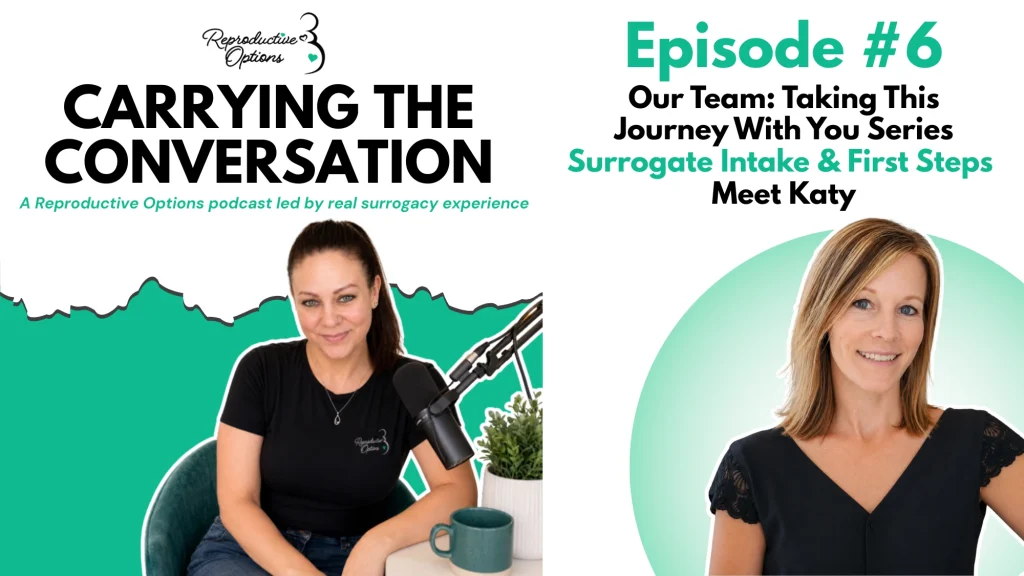
In this episode of Carrying the Conversation, Kayla sits down with Katy Brown, Reproductive Options’ intake manager, to talk about one of the most important parts of the surrogacy process: intake.
Katy is not only the first point of contact for many potential surrogates. She is also a mom, a former surrogate, and someone who understands both the personal and professional sides of this work. Her role is about much more than reviewing surrogate applications. It is about education, connection, support, and helping women understand what they are truly stepping into before they ever match with intended parents.
Katy’s Path to Surrogacy
Before Katy worked in surrogacy professionally, she was a surrogate herself.
She was already a mom and knew her family was complete, but she loved being pregnant. One day, she started wondering whether she could carry a baby for someone else. At the time, she did not even know if that was something people actually did.
So she started researching.
She discovered that surrogacy was real, possible, and something she felt deeply pulled toward. After doing her own research, she brought the idea to her husband, expecting him to think she was completely out of her mind.
Instead, he was on board.
That support helped her move forward. She matched with her intended parents around 2013 or 2014, and more than a decade later, she still brings that lived experience into every conversation she has with potential surrogates.
That matters.
When someone is first exploring surrogacy, it can feel overwhelming. There are medical questions, legal questions, financial questions, emotional questions, family questions, and sometimes a lot of fear about whether they are even “allowed” to ask those questions.
Katy’s role is to make that first step feel less intimidating.
Surrogate Intake Should Be Personal, Not Just Paperwork
At Reproductive Options, surrogate intake is not treated like a quick checklist.
Yes, there are forms. Yes, there are records. Yes, there are qualifications and guidelines that matter. But surrogate intake is also a conversation.
It is the stage where potential surrogates can ask what the journey really looks like. How much time does it take? What are the medications like? What happens during legal contracts? How does escrow work? How are payments handled? What happens if a transfer does not work? What does medical screening involve?
Katy shared that many applicants want to understand the journey as a whole. They may assume surrogacy will feel similar to one of their own pregnancies: get pregnant, go to appointments, deliver, and recover.
But surrogacy includes so much more.
There are applications, record reviews, surrogacy agency forms, interviews, medical screening, psychological screening, legal contracts, medications, monitoring appointments, embryo transfer, beta testing, possible failed transfers, pregnancy care, delivery planning, postpartum support, and sometimes pumping.
That is why surrogate intake has to be educational.
A surrogate should not feel like she is being rushed through the process just to get to a match. She should understand what she is committing to before she moves forward.
Why Partner and Family Support Matters in Surrogacy
One of the biggest themes in this surrogacy podcast episode is support.
Surrogacy affects the entire household, not only the person carrying. Partners may have questions that are different from the surrogate’s questions. They may wonder what the medications are like, how travel works, what delivery could look like, how risk is handled, or what their role will be through the process.
Katy shared that she has had spouses join Zoom calls during intake, and those conversations can be incredibly helpful. It gives partners a chance to ask directly, hear from someone with experience, and feel more included in the process.
Kayla also emphasized that family support can make a journey feel stronger from the beginning. When partners, children, parents, or close friends understand the process and are rooting for the surrogate, it creates a more connected and stable support system.
That does not mean everyone in a surrogate’s life will understand surrogacy right away. Some people may have concerns. Some may need education. Some may need time.
But having open conversations early matters.
Reproductive Options can also help connect potential surrogates with repeat surrogates, or connect partners with other partners who have been through the journey. Sometimes, hearing from someone with real-life experience is exactly what a family needs before taking the next step.
Surrogacy Research Is Important, But Not Every Space Is Helpful
There are more surrogacy resources available now than ever before.
There are Facebook groups, surrogacy agency websites, podcasts, blogs, social media accounts, guidebooks, and online communities where women can learn about the process. Those spaces can be helpful, especially for someone who is just beginning to explore surrogacy.
But they can also be overwhelming.
Kayla and Katy talked about the reality of surrogacy groups online. Some are educational and supportive. Others can become negative, intimidating, or toxic. People may speak more harshly behind a keyboard than they would in person, and someone asking a genuine question can sometimes feel attacked instead of supported.
The advice from this episode is simple: use online groups as a tool, but be careful.
Ask questions. Read different perspectives. Learn from other surrogates. But do not let one comment thread define your entire understanding of surrogacy.
When in doubt, talk to people who can give you real information in a respectful way. Ask a trusted surrogacy agency. Ask an experienced surrogate. Ask a case manager. Ask for resources.
Education should make you feel more informed, not more afraid.
Protection Starts Before Pregnancy in Surrogacy
A major part of the surrogate intake process is helping surrogates understand how protection and benefits work.
Kayla shared an important update about life insurance. Reproductive Options already puts life insurance in place after legal contracts, typically between $500,000 and $750,000, along with additional riders such as reproductive organ loss and total disability coverage.
But the surrogacy agency also recently added a new requirement: a short-term life insurance policy beginning at match.
Why?
Because risk does not begin only at pregnancy.
A surrogate may be asked to start or stop birth control, take supplements, or begin early steps connected to the journey before the longer-term policy is active. While those steps may seem simple, the goal is to make sure surrogates are protected as early as possible.
This is one example of how the surrogacy agency continues to evolve based on what is happening in the field. Kayla talked about listening to surrogacy groups, professional discussions, case managers, and the broader community to ask: What can we do better?
That kind of ongoing reflection matters.
Surrogacy is always changing. Standards shift. Surrogate compensation changes. Insurance changes. Mental health support becomes more visible. Risk conversations evolve. Surrogacy agencies should be paying attention.
Mental Health Support for Surrogates Should Not Be Stigmatized
Another important update discussed in this episode is mental health support.
Reproductive Options recently added a mental health component as a standard part of the surrogate benefit package. Surrogates do not have to use it, but it is available throughout the journey.
This does not have to mean intense therapy or that something is wrong.
It can simply mean having someone in your corner. Someone to check in monthly. Someone to help bridge communication if something feels hard. Someone who understands the emotional weight of surrogacy, pregnancy, hormones, relationships, expectations, and postpartum transition.
As Katy said, some people may think they will never need mental health support. But things can come up. Hormones happen. Stress happens. Relationships shift. Transfers fail. Timelines change.
Having support available before it is needed is a good thing.
It is not a weakness.
It is part of responsible care.
Customizing the Surrogate Compensation and Benefits Package
One thing Katy loves about Reproductive Options is that the benefit package is not treated as one-size-fits-all.
Surrogates can select their own base compensation, and the package can be adjusted based on what works for their family. Maybe one surrogate already has maternity clothes from previous pregnancies and would rather reduce that allowance. Maybe another wants more support for chiropractic care, childcare, lost wages, or another specific need.
Every household is different.
That is why the surrogate intake process includes conversations about what makes sense for the surrogate’s real life.
Surrogacy compensation and benefits should be clear before matching. A surrogate should understand what is included, what can be changed, and what she may want to adjust before contracts are signed.
The financial conversation belongs before the match, not after pregnancy has already begun.
What Happens After the Surrogacy Quiz
Reproductive Options recently launched a new homepage designed to make the process easier to understand from the start. The first step is a video-led quiz that helps potential surrogates begin learning about the process while answering basic qualification questions.
After someone takes the surrogacy quiz, Katy reviews the answers.
She looks for any obvious red flags or areas that need clarification. But she also emphasized something important: qualification is not always black and white.
Not every person is denied because of one condition or one answer. Reproductive Options looks at each surrogate applicant as an individual. Medical history, mental health history, pregnancy history, family support, and overall circumstances all matter.
After the surrogacy quiz, Katy reaches out by email and phone to introduce herself, answer questions, and explain what comes next.
The next step is the full surrogate application.
That application gives the surrogacy agency a deeper understanding of the applicant’s medical history, mental health history, support system, family life, and overall fit for the program.
From there, Katy schedules a call to review answers, clarify anything needed, and begin collecting documents and agency forms.
Building a Surrogate Profile
One of the most personal parts of surrogate intake is building the surrogate profile.
This profile is what helps intended parents get a sense of who the surrogate is before a match call. It includes photos, background information, medical history, preferences, and personality details.
Katy described the questionnaire as a fun part of the process because it helps answer an important question: who do you dream of carrying for?
The profile is not just a form. It is the first emotional connection point between a surrogate and intended parents.
Kayla shared that intended parents may think they have a strict list of requirements, but sometimes a profile just feels right. They may read a surrogate’s story, see her family, understand her personality, and feel connected in a way that goes beyond a checklist.
That is why the surrogate profile matters so much.
Photos Make a First Impression in Surrogacy
Katy and Kayla were honest about one of the most challenging parts of building profiles: photos.
Photos matter.
They help intended parents see the person behind the application. They create warmth, personality, and connection. A good profile photo does not need to be professional, but it should feel thoughtful.
Katy recommends photos that show who the surrogate truly is: family moments, vacations, activities, good individual photos, and pictures that reflect her real life.
Kayla also made an important point: treat the profile like a first impression.
Bathroom selfies, overly filtered social media photos, or inappropriate photos may not communicate the care and seriousness that the journey deserves. A photo can speak a thousand words, so choosing the right ones matters.
At the same time, Reproductive Options respects privacy. If a surrogate does not want to include her children’s faces in the profile, that is completely fine. The surrogacy agency can note that preference and still create a strong, personal profile.
Medical Records and Clinic Requirements for Surrogates
After documents are collected, the records review process begins.
Reproductive Options uses Gather Records, a third-party records collection service, along with internal review. Medical records are compared against the surrogate’s profile to confirm details like birth weights, gestational ages, delivery history, complications, and other important information.
Katy pointed out something very real: people do not always remember every detail from their pregnancies.
That is normal.
Medical records help create accuracy and make sure the agency is working with the right information.
Kayla also explained that fertility clinic requirements vary widely. One clinic may approve something another clinic will not. Guidelines can change from year to year, and some clinics have unique rules that seem to appear unexpectedly.
That is why a careful records review matters.
The goal is not just to approve someone quickly. The goal is to understand which clinics may be the right fit and whether the journey can move forward safely and ethically.
The Final Surrogate Intake Interview
Before moving into matching, surrogates complete a final interview, usually over Zoom.
This is where Katy reviews the profile, matching preferences, benefits package, next steps, and important topics like medical screening, medications, background checks, home study, and embryo transfer.
The home study is virtual. It is not about whether there are dishes in the sink or laundry on the couch. It is about making sure the surrogate is in a safe, stable environment.
The final interview is also where matching preferences are reviewed carefully.
One of the most important topics is termination stance.
This can be emotional and deeply personal, and it is also one of the most important matching points. If a surrogate has strong beliefs about termination, the agency needs to understand those beliefs so she can be matched with intended parents who feel similarly.
Katy emphasized that having a no-termination stance does not automatically mean someone cannot be matched. There are intended parents who share that view. It may simply take longer to find the right fit.
Kayla added that it is important to think through different circumstances carefully, especially when there may be major life-altering conditions affecting the baby or the intended parents’ future. The goal is not to pressure anyone to change their beliefs. The goal is to make sure everyone understands the weight of the conversation before matching.
Vaccination preferences, location preferences, travel comfort, relationship expectations, and intended parent preferences are also discussed.
The more honest the surrogate is during intake, the better the match can be.
Matching With Intended Parents Works Best When It Is Mutual
Reproductive Options approaches matching with intended parents differently than many surrogacy agencies.
Instead of maintaining a long list of intended parents and assigning the next available surrogate to whoever is at the top, the surrogacy agency limits intended parent onboarding based on surrogate availability.
That means matching is more surrogate-centered.
Kayla explained that Reproductive Options often works with third-party concierge services, attorney referrals, clinic referrals, and other trusted networks to find intended parents who fit the surrogate’s preferences.
This allows the surrogacy agency to cast a wider net and look for the right match, not just the fastest match.
That difference matters.
A strong match is not based only on compensation, location, medical history, or timing. It is also based on connection, trust, communication style, expectations, and how both sides feel after learning about each other.
You Do Not Have to Say Yes to the First Match as a Surrogate
One of the most reassuring points in this surrogacy podcast episode is that a surrogate does not have to say yes to the first match call.
Katy shared that when she was first presented with intended parents, they did not seem like what she had imagined. She had pictured someone local, someone who could attend every appointment, and a relationship that felt close from the beginning.
Instead, the intended parents lived in France.
At first, she felt unsure. But she read their profile, agreed to the call, and immediately felt the connection. The match call sealed it for her.
That story shows both sides of the matching process.
Sometimes a profile that does not look like what someone imagined can end up being exactly right. But also, if the connection is not there, it is okay to say no.
There should not be pressure to accept a match simply because it is presented.
The right fit matters for the surrogate, the intended parents, and the journey as a whole.
Surrogate Intake Is Where Trust Begins
The surrogate intake process is about more than determining whether someone qualifies.
It is where education starts.
It is where support is identified.
It is where questions are answered.
It is where preferences are clarified.
It is where protection begins.
It is where trust is built.
For Katy, being in surrogate intake means being the first person many surrogates speak to when they are still deciding whether this path is right for them. She gets to hear why they want to do this, share her own experience, explain the process, and help them move from curiosity to clarity.
That first connection matters.
Surrogacy is a big commitment. It can be beautiful, empowering, and life-changing, but it is not something anyone should enter without understanding the full picture.
The surrogate intake process should help a surrogate feel informed, supported, respected, and prepared.
At Reproductive Options, that is the goal from the very first surrogacy quiz.
Before the match, before the medications, before the transfer, and before the pregnancy, there is a conversation.
And for many surrogates, that conversation begins with Katy.
Thinking About Becoming a Surrogate but Unsure Where to Begin?
Start with Reproductive Options’ surrogate quiz and connect with our surrogacy agency for education, support, and honest answers about what happens before, during, and after the match.