

Surrogacy support should never feel like checking a box.
It should not feel cold, distant, confusing, or transactional. A surrogate should not be left wondering who to call, what comes next, or whether anyone at her surrogacy agency truly knows what is happening in her journey. Intended parents should not feel like they are navigating one of the most emotional seasons of their lives without steady guidance.
That is where surrogate case management matters.
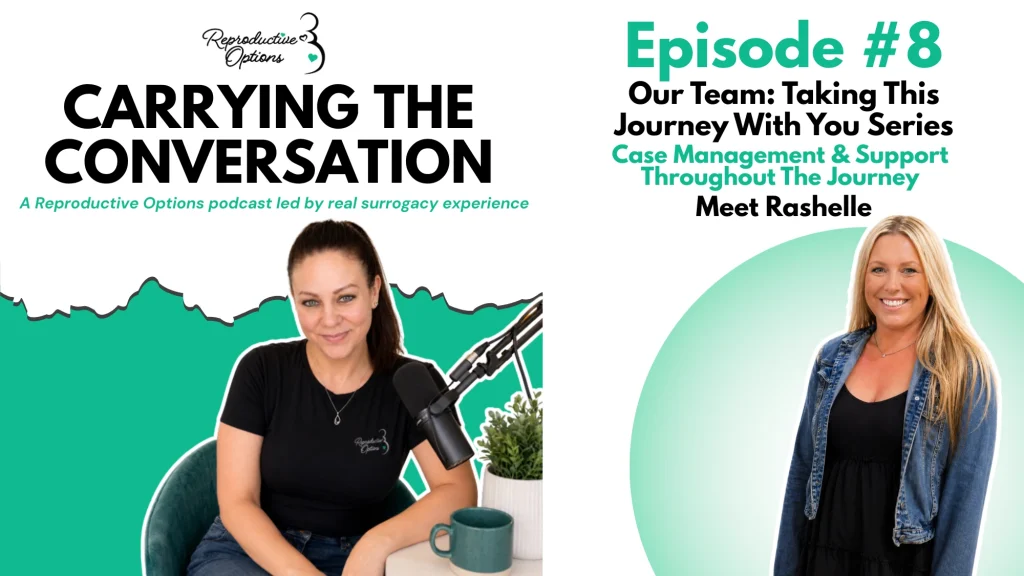
In this episode of Carrying the Conversation, Kayla sits down with Rashelle, one of Reproductive Options’ surrogate case managers, to talk about what real surrogacy support looks like behind the scenes. Rashelle brings a perspective that is deeply personal because before she ever worked in surrogacy professionally, she was a surrogate herself.
Her journey was beautiful in one major way: it gave her a lifelong connection with the intended mother she lovingly calls her “soul sister.”
But her surrogacy agency experience was hard.
There was little support. There were complicated surrogacy agency issues. There was a traumatic delivery. There was a hospital stay in the ICU. And afterward, there was silence.
That experience shaped Rashelle’s approach to surrogacy case management. Today, she uses what she went through to make sure other surrogates feel seen, supported, and cared for in the ways she wishes she had been.
Rashelle’s Path Into Surrogacy
Rashelle’s surrogacy story began as a surrogate with a large surrogacy agency in San Diego.
At that time, she went through a transfer that involved three embryos. Looking back now, with everything she knows about surrogacy, risk, and single embryo transfer standards, she says she would never do that again.
That first transfer failed.
While she was waiting for the intended mother to complete another egg retrieval cycle, Rashelle was approached by her surrogate case manager, who was leaving to start her own surrogacy agency. Rashelle became that new agency’s first surrogate.
She eventually matched with intended parents she adored.
The second transfer involved two embryos, and both stuck. Rashelle carried twins, a boy and a girl, for a family she still remains close with today. She and the intended mother built an incredibly close relationship and continue to talk regularly. The twins send videos. The family FaceTimes. Even with distance and military moves, the connection has remained meaningful.
That relationship became the bright spot of the journey.
But the surrogacy support around the journey was missing.
When Surrogacy Agency Support Falls Short
Rashelle shared honestly that while her relationship with the intended parents was amazing, the surrogacy agency side of the experience was not.
She and the intended parents leaned heavily on each other because they did not feel supported by the surrogacy agency. At one point, they even worked with their attorneys to remove the surrogacy agency from parts of the communication process because the support had become so difficult.
Then came delivery.
Rashelle did not have a simple birth experience. She ended up in the ICU and required 14 blood transfusions.
That is not a small complication.
That is a serious, traumatic medical experience.
And in that vulnerable moment, what she remembers from the surrogacy agency is not steady support, advocacy, or emotional care. She remembers them showing up with flowers, even though flowers were not allowed in the ICU. She remembers the nurse questioning who they were and ultimately making them leave.
After that, Rashelle says she received nothing.
No meaningful follow-up.
No postpartum support.
No continued care.
No real closure.
For anyone listening who is considering surrogacy, this part of Rashelle’s story is important. Surrogacy can be beautiful, but it is also a pregnancy. Pregnancy carries risk. Delivery can become complicated. Postpartum recovery matters.
Surrogacy support should not disappear when things get hard.
It should show up even stronger.
Why Difficult Experiences Can Shape Better Surrogate Case Managers
Kayla and Rashelle talked about something that comes up often in the surrogacy field: many professionals enter this work from one of two places.
Some had a wonderful surrogacy experience and want to stay connected to the field because they loved it so much.
Others had an experience where something went wrong, something felt unsupported, or something could have been done better — and they decide they want to help fix that for someone else.
Rashelle falls into the second group.
She knows what it feels like to need someone and not have them there. She knows what it feels like to rely on intended parents for support because the surrogacy agency is not showing up. She knows what it feels like to experience a traumatic delivery and then feel forgotten afterward.
That lived experience now informs how she supports surrogates.
She does not view surrogate case management as just scheduling appointments or sending emails. She views it as being present, consistent, and emotionally available through the highs and lows of the process.
That is the kind of care she wanted.
Now it is the kind of care she gives.
From Teaching to Surrogacy Case Management
Before becoming a surrogate case manager, Rashelle was on the path to becoming a teacher.
She was a stay-at-home mom, going to school in the evenings, and balancing family life. During her twin pregnancy as a surrogate, she was also finishing school. In fact, she shared that around finals time, she went to a doctor’s appointment and was told she was not going to be taking her final that day — she was going to the hospital to have the babies.
Eventually, she graduated from San Diego State and began working in a school district.
But life was busy.
Her oldest was in high school, playing football and baseball, and Rashelle found that all of her vacation time was going toward getting him to games. She was also navigating the process of adopting her youngest child through foster care, with social workers regularly coming in and out of the home.
Then she saw a post from a friend about a job opening for an office role.
It turned out to be case management for a surrogacy company.
At first, Rashelle did not think she could do it. She had gone to school for teaching and thought she needed to stay on that path. But her friend encouraged her to at least meet with the surrogacy agency owner.
She did.
And the offer gave her the flexibility to keep showing up for her family while stepping into a field that already meant so much to her.
Learning the Surrogacy Field From the Inside
Rashelle’s first professional surrogacy case management role gave her the chance to learn the field behind the scenes.
She is clear that she is grateful for that opportunity. It is hard to break into the surrogacy industry professionally, and someone gave her a chance to learn.
That experience helped her build the foundation she needed.
But it also showed her how overwhelming surrogate case management can become when caseloads are too high.
At that surrogacy agency, Rashelle managed anywhere from 30 to 50 cases at a time. She loved the work and loved the surrogates, but she also acknowledged that with that many people, it was impossible to know every case in the deep, personal way she wanted to.
She had notebooks full of notes. She worked nights and weekends. Her phone rang constantly. She was hourly, but she often worked outside of paid hours because she wanted the surrogates to know she was there for them.
That kind of workload is not sustainable.
And it is not the kind of support Reproductive Options wants surrogates and intended parents to receive.
Why Caseload Size Matters for Surrogacy Support
One of the most important topics in Rashelle’s episode is caseload size.
At Reproductive Options, surrogate case managers typically carry a much smaller number of cases, ideally around 15 to 20. Kayla and Rashelle talk about how that allows for a completely different level of support.
When a surrogate case manager has a manageable caseload, she can know the details.
She can know the surrogate’s history.
She can know the intended parents’ hopes and concerns.
She can remember appointment timelines.
She can anticipate what might come next.
She can communicate proactively.
She can build real relationships.
Rashelle shared that now, she feels like she truly knows her surrogates. She can speak to their details without flipping through endless notes because she is connected to their journeys in a much more personal way.
That matters.
Surrogacy is not a process where people should feel like names on a spreadsheet. Every journey has emotions, risks, timelines, personalities, family dynamics, communication preferences, and unique needs.
Good surrogate case management requires enough time and space to care well.
Supporting Both the Surrogate and Intended Parents
At Reproductive Options, surrogacy case managers support both sides of the journey: the surrogate and the intended parents.
Kayla and Rashelle discussed why that matters.
Some surrogacy agencies separate the support, assigning one case manager to the surrogate and another to the intended parents. While that structure may work in some settings, it can also create gaps. Communication has to travel through multiple people. Relationship-building becomes divided. Important emotional context can get lost.
When one case manager supports both sides, she can understand the journey as a whole.
She can see where the surrogate is emotionally.
She can understand what the intended parents are worried about.
She can help bridge communication.
She can celebrate with both sides.
She can sit with both sides when things are hard.
Rashelle described intended parents as often needing less day-to-day communication than surrogates, but still needing to know there is a real person behind the screen. They need someone who cares about their journey, feels excited with them, and feels sad with them when things do not go as planned.
That human connection matters.
Meeting Each Surrogate Where She Is
Not every surrogate wants the same kind of support.
That is something Rashelle understands deeply.
Some surrogates want frequent texts, updates, check-ins, and conversations throughout the day. They want to share every detail, ask every question, and feel like their case manager is a friend walking beside them.
Others prefer less communication. They may be busy with work, family, children, or life, and they may only want updates when something important is happening.
Neither style is wrong.
Rashelle’s approach is to meet each surrogate where she is.
From the moment she receives a new match, she introduces herself to the surrogate and intended parents. She tries to get everyone on Zoom or a phone call, depending on preference, and begins learning who they are and what kind of support they want.
For first-time surrogates, she often provides more education and reassurance because everything is new. For experienced surrogates, the support may look different. They may know the process but still need someone steady, warm, and available.
The goal is not to force one communication style on everyone.
The goal is to make each journey feel personal.
Local Surrogacy Support and Showing Up in Person
One thing Rashelle loves is when she has local surrogates and can attend appointments with them.
She talked about one surrogate, Bridget, and how excited they both were about the possibility of Rashelle attending the anatomy scan. For Rashelle, showing up in person is another way to support the surrogate, especially when a partner is working or the intended parents live far away.
Many surrogates attend appointments alone.
That can be fine, but it can also feel lonely depending on the appointment, the milestone, or the emotions surrounding the day.
Having a surrogate case manager attend can make the experience feel less isolating.
It says, “You are not doing this by yourself.”
And sometimes, that is exactly what a surrogate needs.
The “Best Friend” Communication Style
Kayla described one of Rashelle’s greatest strengths as her “best friend” communication style.
That does not mean unprofessional. It means warm, open, nonjudgmental, and easy to talk to.
Rashelle tells her surrogates early on that yes, she is their case manager, but she also wants to be their friend through the process. She wants them to feel comfortable coming to her with questions, updates, emotions, and even the things they might label as “TMI.”
In surrogacy, there is often no such thing as too much information.
Pregnancy, IVF, medication side effects, delivery recovery, pumping, postpartum healing, and body changes are all personal. Sometimes they are awkward. Sometimes they are funny. Sometimes they are uncomfortable.
A surrogate needs someone she can talk to without feeling judged.
Rashelle creates that space.
She wants surrogates to know they can tell her the real things, not just the polished updates.
Surrogacy Case Management Is Emotional Work
Rashelle also talked about the emotional weight of surrogacy case management.
This work is joyful, but it is not always easy.
On the same day, a case manager may receive news that one surrogate delivered a baby and another had a failed transfer. One family may be celebrating while another is grieving. One surrogate may be sending photos from a beautiful appointment while another is processing disappointment.
Case managers feel that.
Rashelle shared that she gets emotional when things do not work out because she knows how badly the intended parents want a baby. She knows what the surrogate has invested. She knows the hope that surrounds every transfer and every beta.
That empathy is part of what makes her good at her job.
But it also requires balance.
Kayla talked about how important it is for professionals in this field to take care of themselves personally so they can continue showing up professionally. When your heart is in the work, the hard days hit differently.
That is the reality of working in surrogacy.
The highs are incredibly high.
The lows can be heavy.
And both matter.
Surrogacy Support Should Be Proactive, Not Reactive
One of the biggest differences between true surrogacy case management and surface-level coordination is proactivity.
Checking boxes is not enough.
A case manager should not only respond after something has already gone wrong. She should be thinking ahead, anticipating needs, communicating next steps, helping prevent confusion, and making sure the surrogate and intended parents feel guided.
Rashelle’s own journey showed her what it felt like when support was missing.
Now, she wants to provide the opposite.
That means answering questions before someone feels lost.
It means being available when something feels scary.
It means knowing the case well enough to spot potential issues.
It means communicating with warmth and consistency.
It means not making the surrogate or intended parents chase support.
Surrogacy has enough uncertainty built into it.
The surrogacy agency should not add more.
Expanding Emotional Support Through Mental Health Care for Surrogates
Another important part of this episode is Reproductive Options’ expansion of mental health support.
Kayla shared that the surrogacy agency is adding journey-long mental health support for surrogates, with monthly check-ins available through the same professional who often completes the psychological evaluations.
Rashelle immediately connected with the value of that support because she personally had something similar during her own journey.
Even though she initially wondered what she would talk about, she ended up looking forward to those monthly appointments. They gave her another person to talk to, someone outside the surrogacy agency structure and outside her personal life.
That kind of support can be incredibly valuable.
Sometimes a surrogate may not want to tell her case manager everything. Maybe something is happening at home. Maybe she is processing emotions that feel private. Maybe hormones, stress, or anxiety show up unexpectedly.
Having mental health support already established means the surrogate does not have to start from scratch if she needs help.
It is there from the beginning.
And needing it should never carry a stigma.
The Larger Team Around a Surrogate
Rashelle’s episode also introduces a broader idea: a surrogate’s team is larger than the internal surrogacy agency staff.
Yes, case managers, intake managers, program supervisors, and agency owners matter. But there are also other professionals who help make a journey smooth and safe.
Mental health professionals.
Attorneys.
Escrow teams.
Fertility clinics.
OB providers.
Hospital staff.
Insurance professionals.
Each person plays a role.
Kayla shared that upcoming surrogacy podcast episodes will explore these additional team members and how they support the surrogate’s journey. That is important because surrogacy does not happen in isolation. It is a coordinated process with many moving parts.
The more supported and connected the team is, the smoother the journey can feel.
Why Real Surrogacy Support Feels Like Home
Toward the end of the surrogacy podcast episode, Kayla described the goal of support as creating something that feels like home.
That does not mean every journey is easy. It does not mean that nothing goes wrong. It does not mean there will never be failed transfers, insurance issues, hard conversations, pregnancy discomfort, or emotional moments.
It means that even when there are setbacks, the surrogate still feels supported.
She feels informed.
She feels cared for.
She feels like someone knows her.
She feels like her agency is paying attention.
She feels like she is not alone.
That is what Rashelle brings to surrogacy case management.
Her warmth, communication style, lived experience, and big heart all shape the way she shows up for surrogates and intended parents.
She knows what poor support feels like.
And because of that, she is committed to providing something better.
Turning Pain Into Purpose for Surrogates
Rashelle’s story is a reminder that difficult experiences can become powerful sources of purpose.
Her surrogacy journey gave her one of the most meaningful relationships of her life. It also gave her a clear understanding of what can happen when a surrogacy agency does not show up the way it should.
Both truths exist together.
She can be grateful for the intended parents and the twins.
She can love the relationship that came from the journey.
She can also acknowledge that the surrogacy agency’s support failed her.
Now, as a surrogate case manager, she carries those lessons forward.
She supports surrogates the way she wishes she had been supported. She communicates with warmth. She keeps her caseload personal. She makes herself available. She celebrates the good news and feels the hard news. She shows up as a professional, but also as a person.
That is what real case management should be.
Not just logistics.
Not just paperwork.
Not just appointment reminders.
Real case management is care that carries the surrogacy journey.
And for Rashelle, that care comes from the heart.
Wondering What Real Surrogacy Support Should Look Like After Matching?
Follow Carrying the Conversation for honest conversations with surrogates, case managers, and professionals who understand the surrogacy journey from personal experience and believe support should last every step of the way.