
Surrogacy stories often end with a delivery room, a baby placed into the arms of intended parents, and an emotional moment that makes every appointment, injection, contract, and anxious wait feel worth it.
But not every surrogacy journey ends that way.
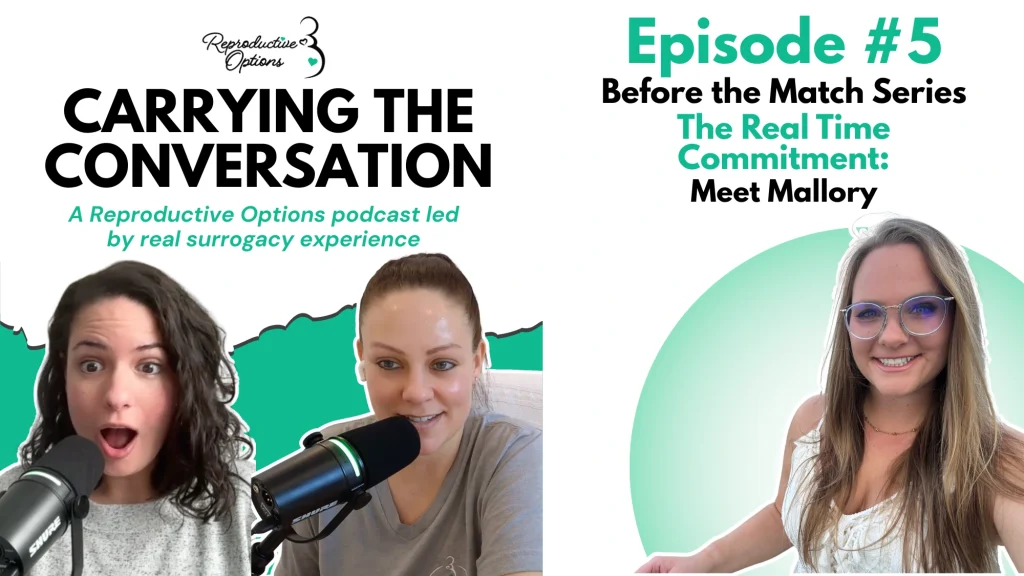
In this episode of Carrying the Conversation, Kayla and Gabby sit down with Mallory, a former Reproductive Options surrogate from Atlanta whose surrogacy journey took a very different path. Mallory did the work. She matched. She traveled. She took medications. She transferred. She experienced pregnancies. She went through procedures, delays, failed cycles, and match breaks.
But she did not deliver.
And still, as Mallory said so beautifully, she considers herself a surrogate.
Her story is one of the most important conversations in the Before the Match series because it highlights a truth that every potential surrogate deserves to understand: you can enter surrogacy with the right heart, the right support, and the right commitment, and still not end up delivering a baby.
That does not mean the journey did not matter.
It means surrogacy is bigger, more complex, and more emotionally layered than the ideal version people often imagine when they first apply.
Surrogacy Requires Commitment to the Process
When many women first begin exploring surrogacy, it is natural to picture the big milestones.
The match call.
The medical clearance.
The transfer.
The positive test.
The pregnancy.
The delivery.
The intended parents meeting their baby.
Those moments are real, and they are beautiful. But they are not guaranteed.
Mallory’s story shows what can happen between the steps on the checklist. Her journey included multiple transfers, unexpected medical complications, long waits, changing timelines, difficult conversations, and the emotional weight of continuing to show up when things did not go as planned.
That is one of the most important pieces of education for anyone considering surrogacy.
You are not only committing to a pregnancy. You are committing to a process.
And that process may include failed transfers. It may include chemical pregnancies. It may include miscarriages or a pregnancy of unknown location. It may include procedures, medication changes, additional testing, or a match ending before anyone expected it to.
Surrogacy asks a lot of the body, but it also asks a lot of the heart.
How Mallory Found Surrogacy
Mallory’s connection to surrogacy started before her own journey began.
Her mother had once tried to carry for Mallory’s aunt, although it did not work out. At the time, Mallory was young and did not fully understand what surrogacy meant, but the idea stayed somewhere in the background.
Later, a neighbor helped bring the idea back into focus. Mallory met someone in her neighborhood who had been connected to surrogacy, and that opened the door to more conversations.
Eventually, Mallory told her husband, Ryan, that she wanted to do it.
At first, like many partners, Ryan had questions. Surrogacy affects the entire household. It is not only the surrogate who signs up for the process. Partners carry emotional weight, too. They support through medication schedules, travel, disappointment, hormones, contracts, appointments, and uncertainty.
But after Mallory talked through the surrogacy process with him, Ryan supported her.
That support became incredibly important because Mallory’s journey would require far more endurance than either of them expected.
Her First Intended Parent Match and First Transfer as a Surrogate
Mallory officially applied with Reproductive Options in August 2023 and matched with her first intended parents a few months later. She traveled to Washington, D.C. for medical screening, received clearance, started medications, and had her first transfer in February.
At first, everything looked hopeful.
She had a good relationship with the intended parents. Ryan traveled with her. The screening looked good. The transfer happened. Then came the waiting period every surrogate knows well: testing, watching for lines, sending photos, and trying to balance hope with reality.
Mallory started seeing faint possibilities on home tests, but the results were inconsistent. By the time she went in for her first beta, she was prepared for it to be negative.
Instead, the beta came back low but positive.
That created a complicated emotional space. There was hope, but cautious hope. The number rose, but not the way it should. More blood draws followed. The numbers continued creeping up, but they were not doubling appropriately.
Then Mallory began having pain and went to the emergency room.
The pregnancy could not be clearly located on ultrasound, and her hCG levels continued to behave abnormally. Eventually, the situation became what was described as a pregnancy of unknown location. Her medications were stopped, but the hCG still kept rising.
What followed was a physically and emotionally difficult stretch.
Procedures, Waiting, and Methotrexate
Mallory’s care team tried to avoid methotrexate at first because receiving it would delay another transfer by several months. She underwent a D&C, but afterward, her hCG still rose.
There was nothing clearly found.
That meant methotrexate became necessary.
Methotrexate is a serious medication, and in this context, it is used when there is concern for an ectopic pregnancy or pregnancy tissue that is not resolving appropriately. For Mallory, it also meant a forced delay in the surrogacy process.
That kind of delay can be incredibly hard.
A surrogate may be emotionally ready to try again. Intended parents may be anxious to move forward. Everyone may want answers. But the body has its own timeline, and safety has to come first.
Mallory had to wait. Then she had to return for another medical clearance to make sure everything looked good before attempting another transfer.
This is one of the realities of surrogacy that does not always get enough attention. A surrogacy journey can pause for months because of something no one wanted and no one could control.
Trying Again After a Difficult Loss
After the delay, Mallory went back for another evaluation. Everything looked clear, and she moved toward another transfer with the same intended parents.
That transfer was not successful.
At that point, the fertility clinic recommended additional testing, including an ERA with biopsy, to look more closely at her receptivity and timing for transfer. The results showed that her progesterone timing may have needed adjustment, which could have affected implantation.
This information was helpful, but by then, the surrogacy journey itself had become complicated in other ways.
The intended parents had personal circumstances unfolding at the same time, including the intended mother becoming pregnant herself. As their lives shifted, the timing and emotional alignment of the surrogacy journey became more difficult.
Eventually, Mallory and the intended parents broke the match.
For Mallory, that ending was painful. She had invested more than a year into the match. She had gone through transfers, a pregnancy of unknown location, procedures, delays, and emotional ups and downs.
And then it was over.
Choosing to Keep Going as a Surrogate
After everything that happened in her first match, Kayla expected Mallory might be done.
Many people would have been.
But Mallory talked with Ryan and decided she wanted to try again.
That choice says so much about her heart. Not because every surrogate should continue after hardship, but because Mallory still felt connected to the purpose of surrogacy. She still wanted to help. She still felt there might be another path forward.
After some match calls that did not work out, Mallory matched again.
This second match brought a new intended father, a new clinic, and a new location: Sacramento, California. Mallory had never traveled that far west before, and the journey brought a different kind of excitement.
The intended father seemed like a great fit. His profile stood out. He had tattoos, a unique story, and a personality that felt less “status quo.” Mallory felt hopeful.
Once again, she traveled for a medical screening. Once again, she moved forward.
But as had become a theme in her story, even the straightforward parts were not always straightforward.
Another Screening, Another Transfer, Another Hope
At medical screening, the provider initially thought Mallory might have adhesions, which would have meant another possible procedure. After everything she had already been through, that possibility felt overwhelming.
Thankfully, after further review, everything was fine, and Mallory received clearance.
She moved forward with the transfer.
One of the lighter moments of her journey happened during a transfer in California. The room was quiet, classical music was playing, and Mallory asked if she could play Taylor Swift instead.
The doctor agreed.
In a process that can feel sterile, clinical, and emotionally charged, that little moment mattered. It was funny, human, and very Mallory.
But that transfer did not work.
They tried again. The fertility clinic used Lupron, which stretched the medication timeline longer. Mallory followed the protocol, traveled again, transferred again, and started testing again.
This time, she saw a faint line.
There was a moment of hope. A line appeared. People saw it. It seemed like maybe, finally, this could be the one.
But the beta came back extremely low, consistent with a chemical pregnancy.
Again, Mallory had to absorb the news. Again, the intended parent had to absorb the news. Again, the journey shifted.
When the Second Intended Parent Match Ended
After the chemical pregnancy, Mallory began preparing herself emotionally for the possibility that the intended father might decide to end the match.
He had been kind and supportive throughout the journey. He had expressed gratitude. But surrogacy is also expensive, emotional, and deeply personal for intended parents. Every failed transfer carries grief and uncertainty for them, too.
A few days later, Mallory learned that he wanted to break the match and had moved his embryo elsewhere.
The ending felt disappointing and, in some ways, blindsiding. Mallory understood that he had his own grief and his own future to consider. She did not hold hard feelings toward him. But the loss was still real.
At that point, Mallory also knew what Kayla knew: this was likely the end of her surrogacy path.
After multiple transfers, failed outcomes, and a complex history, finding another match would be difficult. Intended parents often want the candidate they feel gives them the best chance of success, and Mallory did not feel confident that she would be viewed that way anymore.
That realization hurt.
There were tears.
There was grief.
And there was also perspective.
“I Didn’t Deliver, But I’m Still a Surrogate”
One of the most powerful moments in Mallory’s surrogacy podcast episode is when she says that even though she did not deliver, she still considers herself a surrogate.
That sentence is the heart of this episode.
Surrogacy is not only defined by the delivery room.
Mallory went through the screening. She signed contracts. She took medications. She traveled. She transferred embryos. She experienced pregnancies. She had procedures. She adjusted her life around the process. She gave her time, her body, her hope, and her heart.
She showed up again and again.
That matters.
There can be a tendency to define surrogacy by the outcome, but Mallory’s story challenges that. A woman does not become a surrogate only at delivery. She becomes a surrogate when she commits to carrying for someone else and steps into the process with intention.
Mallory did that.
And even without a baby at the end of her journey, her experience as a surrogate still counts.
The Emotional Side of Ending Without Delivery in Surrogacy
Ending a surrogacy journey without delivery is complicated.
There may be grief, but it is not always the kind of grief people immediately understand. Mallory was not grieving a baby she planned to parent. She was grieving the role she hoped to fulfill. She was grieving the intended outcome. She was grieving the time, effort, hope, and purpose she had poured into the process.
She was also grieving relationships and possibilities.
Kayla shared how difficult it was to have the conversation with Mallory that surrogacy was likely over. Their relationship had grown over the years of working together. Mallory had been there through many stages of Reproductive Options’ growth, from the days when Kayla was managing cases on her own to the larger team the surrogacy agency has now.
Mallory was not just another surrogate profile.
She was someone who had become part of the surrogacy agency’s story.
That is part of what makes this surrogacy podcast episode so emotional. It is not only about medical outcomes. It is about the people inside the surrogacy process.
Why Support Matters So Much During Surrogacy
One thing Mallory emphasized is that she never felt like just a number.
Even after her surrogacy journey ended, Reproductive Options still cared about her. She received a gift box from the surrogacy agency, and the timing of opening it right before the surrogacy podcast episode felt especially meaningful.
For someone else, Mallory said, she could have simply been marked as “done” and forgotten.
But that was not her experience.
She still felt seen as a friend, a sister, and a surrogate.
That kind of support matters in every surrogacy journey, but it may matter even more when the journey ends without the expected outcome. Surrogates need care during pregnancy, of course. But they also need care through failed transfers, match breaks, procedures, disappointments, and endings.
Support should not disappear just because the outcome changed.
Sharing the Hard Parts in Surrogacy So Others Feel Less Alone
Mallory also shared her surrogacy journey publicly on social media.
At first, like many surrogates, she hoped she would be documenting a more typical story: match, transfer, pregnancy, delivery, happy ending.
Instead, she documented the hard parts too.
And because she did, other women were able to find her. Some were going through similar experiences. Some were facing failed transfers or confusing betas. Some were scared, disappointed, or unsure what was happening in their own journeys.
Mallory’s surrogacy story became a resource.
That is one of the reasons conversations like this matter so much. The hard stories are not shared to scare people away from surrogacy. They are shared so people enter the surrogacy process with open eyes.
Most journeys do not look like Mallory’s. Many are smooth. Many do end in delivery. Many unfold with fewer complications.
But some do not.
And the women in those surrogacy journeys deserve to know they are not alone.
The Reality of Science, Timing, and Control During Surrogacy
Mallory said something in the surrogacy podcast episode that every surrogate should hear: it does not matter how badly you want it. It is still science.
That truth can be hard to accept.
A surrogate can do everything right. She can take every medication exactly as instructed. She can show up to every appointment. She can have a strong lining, a beautiful embryo, a supportive team, and a hopeful match.
And still, the transfer may not work.
That does not mean she failed.
It means reproduction is complex. IVF is complex. Pregnancy is complex. Surrogacy is not a guaranteed path, even when everyone does everything they are supposed to do.
For intended parents, that uncertainty can be heartbreaking.
For surrogates, it can be emotionally confusing. They may feel responsible even when they are not. They may wonder what else they could have done. They may question their bodies, their choices, or their place in the process.
Mallory’s story reminds us that sometimes there is no simple explanation.
Sometimes, you try.
And trying still matters.
Committed to More Than the Perfect Ending in Surrogacy
As Kayla shared in the surrogacy podcast episode, Reproductive Options wants surrogates to understand that the commitment is not only to the ideal version of the journey.
It is easy to say yes to medical screening, legal contracts, transfer, pregnancy, and delivery.
It is harder to say yes to the unknowns.
A surrogate may need to be prepared for more than one transfer. She may need to be prepared for a failed cycle. She may need to be prepared for delays, procedures, medication changes, difficult phone calls, or a match that ends before delivery.
That does not mean she has to commit forever.
Mallory spent more than two years in the surrogacy process. There came a point when it made sense for her to close that chapter and move forward with her life. After her contract ended, she and Ryan booked a cruise and went to Mexico.
That was the right next step for them.
Surrogacy had taken time, energy, and emotional space. It was okay to reclaim that space.
Still Part of the Surrogacy Story
Mallory’s journey may not have ended with delivery, but it still left an impact.
It impacted the intended parents she matched with. It impacted the surrogacy agency team, who walked alongside her. It impacted the people who followed her story online. It impacted other surrogates who found comfort in knowing someone else had been through something hard, too.
And it impacted Mallory.
She learned from it. She gave everything she could. She found purpose in sharing the truth, even when the truth was not the ending she had hoped for.
That is what makes her story so valuable.
Surrogacy is not only the picture-perfect moment at the end. It is the courage to begin. The strength to continue. The honesty to say when something hurts. The wisdom to know when it is time to stop. And the grace to still honor the journey, even when it does not become what you imagined.
Mallory did not deliver.
But she is still a surrogate.
And her story belongs in the conversation.
Considering Surrogacy and Wanting to Understand the Full Reality of the Surrogacy Process?
Follow Carrying the Conversation for honest stories from surrogates, transparent education, and real conversations about the beautiful, complicated, and sometimes unexpected parts of the journey.